1. General Style Guidelines
1.1. Spelling and punctuation
Guideline(s)
1. Authors may choose to use either UK or US spelling and punctuation, but there must be consistency throughout their writing.
2. Use the serial comma/Oxford comma before the “and” in a list of three or more items.
3. For quotations, use double quotation marks with commas and full stops placed inside the quotation marks.
4. Use single quotation marks for a quotation within a quotation.
5. All proper nouns ending on the letter “s” are written with an apostrophe and an additional “s” in the possessive.
Example(s)
(The numbers in square parentheses refer to rules 1–5)
colour/color; recognise/recognize; travelling/traveling [1]
Smith, Ntseno, Jones, and Marks. [2]
Smith notes: “That is the entire purpose.” [3]
Smith states that “according to Ntseno, it is ‘absolutely vital’ to prioritize.” [4]
Jesus’s; Moses’s. [5]
Smith, Ntseno, Jones, and Marks. [2]
Smith notes: “That is the entire purpose.” [3]
Smith states that “according to Ntseno, it is ‘absolutely vital’ to prioritize.” [4]
Jesus’s; Moses’s. [5]
1. General Style Guidelines
1.2. Formatting: Font and headings
Guideline(s)
1. Font color: black.
2. Font size: 12pt.
3. Authors may choose to use either Arial or Times New Roman as font style but there must be consistency throughout their writing.
4. Line spacing: 1.5.
5. Paragraphs are distinguished by a single line space.
6. Paragraph alignment should be justified.
7. It is advised that headings be kept at a maximum of three levels.
8. Authors should use the styles function in their word processor to classify headings accordingly.
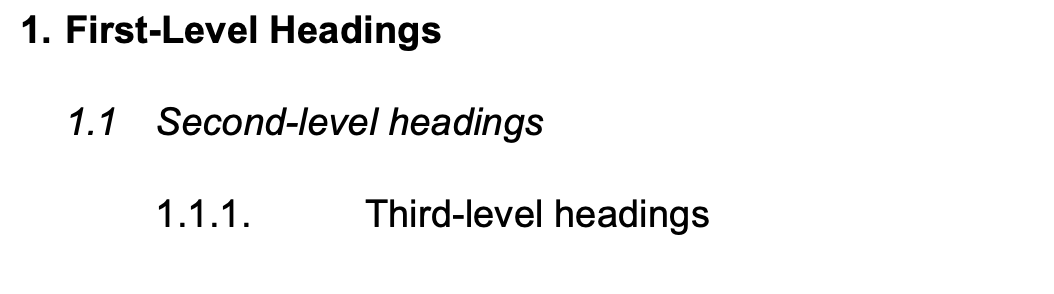
9. Headings should numbered and set out as follows:
• First-Level Headings (Each new word capitalized, bold).
• Second-level headings (First word capitalized, italics; justified, indented: 1,27 cm).
• Third-level headings (First word capitalized; justified; indented: 2,54 cm).
Example(s)
(All examples demonstrate rules 1–2; the numbers in square parentheses refer to rules 3–9)
Use either Arial or Times New Roman, but be consistent. [3]
Lorem ipsum dolor sit amet, consectetur adipiscing elit, sed do eiusmod tempor incididunt ut labore et dolore magna aliqua. Ut enim ad minim veniam, quis nostrud exercitation ullamco laboris nisi ut aliquip ex ea commodo consequat.
Duis aute irure dolor in reprehenderit in voluptate velit esse cillum dolore eu fugiat nulla pariatur. Excepteur sint occaecat cupidatat non proident, sunt in culpa qui officia deserunt mollit anim id est laborum. [4, 5, 6]
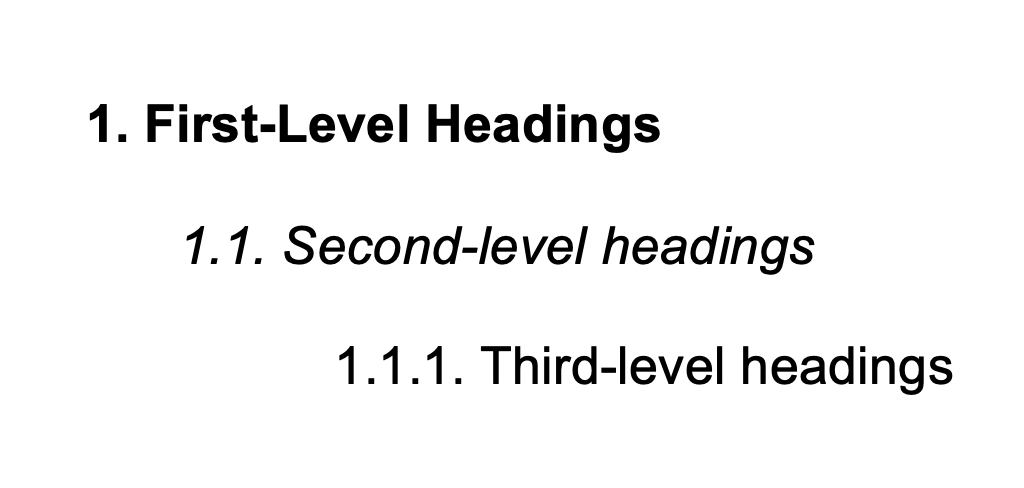
[7, 8, 9]
1. General Style Guidelines
1.3. Formatting: Capitalization
Guideline(s)
1. Authors should be consistent in using capitalization.
2. Words are capitalized if they are used as titles, while the literary type of the word would be written in lowercase.
3. If used adjectivally, lowercase is prescribed.
4. Nouns used for God are capitalized.
5. Write pronouns for God (he; him; his) in lowercase.
6. Official terminology relating to Jewish tradition is capitalized.
7. In the case of surnames preceded by particles, capitalize according to the standard use employed by the specific author. Particles should have the same case throughout the text (including running text, footnotes, indexes, and bibliographies), whether preceded by names/initials or not.
Example(s)
(All examples demonstrate the first rule; the numbers in square parentheses refer to rules 2–8)
The Gospel of John [2]
Jesus’s words are recorded in the gospels. [2]
We should share the gospel as good news. [2]
The Bible is God’s revelation thus the biblical text is translated with care. [2, 3]
Son of Man; Lamb; Lord; Shepherd [4]
The Lord, he is God, and his power extends eternally. [5]
Law; Hebrew Scriptures; Sabbath; Septuagint; Feast of Booths; Gentiles; Pagans; Diaspora [6]
(van Deventer; von Rad) [7]
Van Deventer argues that John wrote the Fourth Gospel. [8]
Jesus’s words are recorded in the gospels. [2]
We should share the gospel as good news. [2]
The Bible is God’s revelation thus the biblical text is translated with care. [2, 3]
Son of Man; Lamb; Lord; Shepherd [4]
The Lord, he is God, and his power extends eternally. [5]
Law; Hebrew Scriptures; Sabbath; Septuagint; Feast of Booths; Gentiles; Pagans; Diaspora [6]
(van Deventer; von Rad) [7]
Van Deventer argues that John wrote the Fourth Gospel. [8]
1. General Style Guidelines
1.4. Formatting: Capitalization of titles
Guideline(s)
1. Titles mentioned or cited in the Works Cited list are capitalized in title case.
2. Capitalize the first and last words in titles and capitalize all other major words (nouns, pronouns, verbs, adjectives, and adverbs).
3. Lowercase the articles "the," "a," and "an."
4. Lowercase prepositions.
5. Capitalize prepositions when they are used adverbially or adjectivally.
6. Lowercase the common coordinating conjunctions "and," "but," "for," "or," "nor."
7. Lowercase "to" and "as" in any grammatical function.
8. Always capitalize the first element of hyphenated compounds in titles.
9. Capitalize any subsequent elements (unless they are articles, prepositions, or conjunctions).
10. If the first element is merely a prefix that could not stand by itself as a word, do not capitalize the second element.
11. If the first element is merely a prefix that could not stand by itself as a word, capitalize the second element if it is the name for a specific place, person, or thing.
12. Capitalize the second element in a hyphenated spelled-out number.
13. Separate titles and subtitles with a colon (not a period, semicolon, comma, or dash). This rule may be applied regardless of the punctuation on the title page.
14. Ampersands (&) found in original titles should be changed to and in formatting.
Example(s)
(All examples demonstrate the first rule; the numbers in square parentheses refer to rules 2–14)
Practices That Work Are Better Than Rules That Do Not.
A Little Learning Is a Dangerous Thing [2, 3]
Four Theories concerning the Gospel according to Matthew [2, 3]
Biblical Theology and from Where It Came [3, 4]
Taking Down Names, Spelling Them Out, and Typing Them Up [5]
Tired but Happy [6]
The Cost for Witnessing to Christ in Nigeria [7]
Child-Friendly Spaces as Spaces of Hope [7, 8]
Under-the-Counter Transactions and Out-of-Fashion Initiatives [9]
Self-Sustaining Reactions [9]
Anti-intellectual Pursuits [10]
How Theology Thrives with E-books [10]
Interviewing Non-English-Speaking Representatives [11]
Female Theologians of the Twenty-First-Century [12]
Manuals of Style: Guidelines, Not Strangleholds [13]
Spirit Hermeneutics: Reading Scripture in Light of Pentecost [13]
A Brief History of Interpretation and Understanding [14]
A Little Learning Is a Dangerous Thing [2, 3]
Four Theories concerning the Gospel according to Matthew [2, 3]
Biblical Theology and from Where It Came [3, 4]
Taking Down Names, Spelling Them Out, and Typing Them Up [5]
Tired but Happy [6]
The Cost for Witnessing to Christ in Nigeria [7]
Child-Friendly Spaces as Spaces of Hope [7, 8]
Under-the-Counter Transactions and Out-of-Fashion Initiatives [9]
Self-Sustaining Reactions [9]
Anti-intellectual Pursuits [10]
How Theology Thrives with E-books [10]
Interviewing Non-English-Speaking Representatives [11]
Female Theologians of the Twenty-First-Century [12]
Manuals of Style: Guidelines, Not Strangleholds [13]
Spirit Hermeneutics: Reading Scripture in Light of Pentecost [13]
A Brief History of Interpretation and Understanding [14]
1. General Style Guidelines
1.5. Formatting: Abbreviations
Guideline(s)
General abbreviations are marked by periods and can be freely used in parentheses and footnotes but not in the main text. For a list of accepted general abbreviations, see the SBL Handbook of Style (2014, §8.1).
1. Do not use contracted words in formal writing.
2. The abbreviation e.g. is used as "for example." If it is in the middle of a sentence, it is preceded and followed by a comma. If it is preceded by a bracket, it is only followed by a comma.
3. The abbreviation i.e. is used for "in other words." It is always followed by a comma.
4. The abbreviation et al. is used for in-text citations that refer to a work composed by four or more authors. The full stop is only added after "al" and the abbreviation is not italicized.
5. Incorrect or unexpected forms found in quotations are noted by the addition of [sic]. Note that sic is always in italics and enveloped in square brackets.
6. The use of the period abbreviations BC and AD is encouraged. However, you are free to use BCE and CE with motivation. AD precedes the date, while BC, BCE and CE follow it.
7. Use the following abbreviations for words followed by a numerical value:
i. v. for verse; vv. for verses
ii. ch. for chapter; chs. for chapters
iii. p. for page; pp. for pages
8. If any of the above words are not followed by numbers, they are to be written out in full.
9. You may use the abbreviation LXX for the Septuagint and MT for the Masoretic Text or may choose to write these out in full. These abbreviations should be in subscript if inserted after the text.
10. Use periods with abbreviations that end a lowercase letter.
11. Use no periods with abbreviations that include two or more capital letters, even if the abbreviation includes lowercase letters.
Example(s)
(The numbers in square parentheses refer to rules 1–11)
Avoid these in formal writing: it’s, we’ll, they’re [1]
Analyzing the text, e.g., Ephesians 2 brings clarity. [2]
(e.g., Eph 2) [2]
(i.e., the ethos of the believer) [3]
(Jones et al. 2010, 150) [4]
AD 200 [5]
“Paul notes where she [sic] writes with his own hand.” [5]
400 BC [6]
Paul’s argument in this chapter of Romans (vv. 6–12) can be structured as follows. [7]
First, verses are grouped as greetings (ch. 23) and then as instructions (chs. 22–24). [7]
In the first chapter we see a change of tone. [8]
Details appear on the second page. [8]
An analysis of the verse shows a deeper significance. [8]
(Deut 8:1LXX) [9]
(Deut 8:1MT) [9]
a.m. [10]
Ms. [10]
Dr. [10]
DMin [11]
PhD [11]
MDiv [11]
Analyzing the text, e.g., Ephesians 2 brings clarity. [2]
(e.g., Eph 2) [2]
(i.e., the ethos of the believer) [3]
(Jones et al. 2010, 150) [4]
AD 200 [5]
“Paul notes where she [sic] writes with his own hand.” [5]
400 BC [6]
Paul’s argument in this chapter of Romans (vv. 6–12) can be structured as follows. [7]
First, verses are grouped as greetings (ch. 23) and then as instructions (chs. 22–24). [7]
In the first chapter we see a change of tone. [8]
Details appear on the second page. [8]
An analysis of the verse shows a deeper significance. [8]
(Deut 8:1LXX) [9]
(Deut 8:1MT) [9]
a.m. [10]
Ms. [10]
Dr. [10]
DMin [11]
PhD [11]
MDiv [11]
1. General Style Guidelines
1.6. Formatting: Other languages
Guideline(s)
1. Words in ancient languages (Greek; Hebrew; Aramaic) can be transliterated or formatted using proper characters (in the fonts prescribed in this document; see SBL 2014, §5.1).
2. Foreign words that have become technical terms can be transliterated and should be italicized. This includes technical terms from Latin and other foreign languages.
3. Ancient languages (Hebrew, Greek, Aramaic, Syriac, Coptic) should be in Unicode, set in Times New Roman or Arial. Keep in mind that ancient languages look more elegant in Times New Roman.
4. All words or phrases in ancient languages must be accompanied by a translation in parentheses (or footnotes, if the length of the portion warrants it).
Example(s)
(The numbers in square parentheses refer to rules 1–4)
philía; yom; Abba [1]
shalom; koinonia [2]
a priori; caveat [2]
déjà vu [2]
John uses the phrase ἐν ἀρχῇ (in [the] beginning). [3, 4]
shalom; koinonia [2]
a priori; caveat [2]
déjà vu [2]
John uses the phrase ἐν ἀρχῇ (in [the] beginning). [3, 4]
1. General Style Guidelines
1.7. Formatting: Hyphens and dashes
Guideline(s)
1. Hyphens are used in compound words to join the phrasal adjective(s) to the noun it modifies.
2. Write out adjectival hyphened numbers fully
3. When numbers are used as nouns, they are not hyphenated.
4. Use an en dash to connect numbers and indicate number ranges.
5. The em dash is used to set off an amplifying or explanatory element.
Example(s)
(The numbers in square parentheses refer to rules 1–5)
It was a dog-eat-dog competition. [1]
They took the rabbit to a small-animal hospital. [1]
first-century; second-century; twenty-first century. [2]
Believers in the first century faced diverse trials. [3]
The years 1993–2000 were heady ones for the illiterate. [4]
In Genesis 6:13–21 we find God’s instructions to Noah. [4]
Smith (2018, 140–144) portrays a high view of Scripture. [4]
It was a revival of the most potent idolatry—rivaled only by Manassah’s reign in Judah. [5]
The influence of three scholars—Mburu, Amenyedzi, and Mouton—made a huge impact on contextual interpretation. [5]
They took the rabbit to a small-animal hospital. [1]
first-century; second-century; twenty-first century. [2]
Believers in the first century faced diverse trials. [3]
The years 1993–2000 were heady ones for the illiterate. [4]
In Genesis 6:13–21 we find God’s instructions to Noah. [4]
Smith (2018, 140–144) portrays a high view of Scripture. [4]
It was a revival of the most potent idolatry—rivaled only by Manassah’s reign in Judah. [5]
The influence of three scholars—Mburu, Amenyedzi, and Mouton—made a huge impact on contextual interpretation. [5]
2. Abbreviations of Bible Books
Authors may refer to the Testaments as OT and NT.
Do not use any full stops when abbreviating Bible books.
Old Testament
| Genesis | Gen | Song of Songs (Song of Solomon) | Song |
| Exodus | Exod | Isaiah | Isa |
| Leviticus | Lev | Jeremiah | Jer |
| Numbers | Num | Lamentations | Lam |
| Deuteronomy | Deut | Ezekiel | Ezek |
| Joshua | Josh | Daniel | Dan |
| Judges | Judg | Hosea | Hos |
| Ruth | Ruth | Joel | Joel |
| 1–2 Samuel | 1–2 Sam | Amos | Amos |
| 1–2 Kings | 1–2 Kgs | Obadiah | Obad |
| 1–2 Chronicles | 1–2 Chr | Jonah | Jonah |
| Ezra | Ezra | Micah | Mic |
| Nehemiah | Neh | Nahum | Nah |
| Esther | Esth | Habakkuk | Hab |
| Job | Job | Zephaniah | Zeph |
| Psalms | Ps (Plural: Pss) | Haggai | Hag |
| Proverbs | Prov | Zechariah | Zech |
| Ecclesiastes | Eccl | Malachi | Mal |
New Testament
| Matthew | Matt | 1–2 Thessalonians | 1–2 Thess |
| Mark | Mark | 1–2 Timothy | 1–2 Tim |
| Luke | Luke | Titus | Titus |
| John | John | Philemon | Phlm |
| Acts | Acts | Hebrews | Heb |
| Romans | Rom | James | Jas |
| 1–2 Corinthians | 1–2 Cor | 1–2 Peter | 1–2 Pet |
| Galatians | Gal | 1–2–3 John | 1–2–3 John |
| Ephesians | Eph | Jude | Jude |
| Philippians | Phil | Revelation | Rev |
| Colossians | Col |
3. In-Text Citations
3.1. General source citations
Guideline(s)
1. Citations should be written in the following format: surname(s)—space—date—comma—space—page number(s).
2. Citations should be enveloped by parentheses.
3. Page range employs inclusive numbering indicated by an en dash (see §1.7).
4. Multiple references related to a citation should be incorporated in one set of parentheses, organized alphabetically with the content separated by a semicolon and a space.
5. Sources with two or three authors are cited with all the author surnames as given by the publisher (see §4.1).
• Author entries are separated by the oxford comma.
• Use an Oxford comma before the "and" when the final author is listed.
6. Sources written by four or more authors are cited by the surname of the first author, followed by et al. in place of the remaining authors (see §1.5).
7. The in-text citation credits the author, not the editor.
Example(s)
(All examples demonstrate rules 1–2; the numbers in square brackets refer to rules 3–21)
(Achebe 2004, 92)
(Lionel, Richards, and Wick 2023, 155)
(Carstens 2022, 135–139) [3]
(Smith 2018, 201–203) [3]
(Achebe 2004, 92; Lowe 2011, 311; Rhoads 2009, 94) [4]
(Achebe 2004, 92; Ps 119:20–24) [4]
(Lionel, Richards, and Wick 2023, 155)
(Carstens 2022, 135–139) [3]
(Smith 2018, 201–203) [3]
(Achebe 2004, 92; Lowe 2011, 311; Rhoads 2009, 94) [4]
(Achebe 2004, 92; Ps 119:20–24) [4]
The word refers to turning away from the object in order to avoid it (Barry et al. 2016, 136). [6]
According to Barry et al. (2016, 136), the word refers to turning away from the object in order to avoid it. [6]
In the volume edited by Grobbelaar and Breed, the growing scholarly interest in moving beyond the traditional educational paradigm is highlighted (Bunge 2016, 112). [7]
3.1.1. Citations: Some information is not available
Guideline(s)
8. When the publication date of a work cannot be ascertained, the abbreviation n.d. takes the place of the year. Only use this designation when you have made every effort to locate a date for the source.
9. If no page numbers are available, use a section sign/silcrow (§) to cite the section number/section title.
10. If no page numbers or sections are available, use only the date. Do not use n.p. after the date.
Example(s)
(Baxter and Ndhlovu n.d., 14) [8]
(Wood 2014, §4.1.3) [9]
(SATS 2024, §2) [9]
(SATS 2024, §Theological Paradigm Shift) [9]
(Smith 2023) [10]
(Wood 2014, §4.1.3) [9]
(SATS 2024, §2) [9]
(SATS 2024, §Theological Paradigm Shift) [9]
(Smith 2023) [10]
3.1.2. Citations: Multiple works by one author
Guideline(s)
11. For citations of multiple works by one author with different dates, entries are presented in ascending chronological order, separated by a semicolon.
12. For citations of multiple works by one author with the same date, a letter designation is added to the date. Entries are separated by a semicolon.
Example(s)
(White 2001, 110; 2008, 373–374; 2019, 20) [11]
(Grobbelaar 2016a, 108; Grobbelaar 2016b, 75–80) [12]
(Grobbelaar 2016a, 108; Grobbelaar 2016b, 75–80) [12]
3.1.3. Citations: Positioning the citation
Guideline(s)
13. For uninterrupted repeat citations of the same source in a paragraph, simply include the page numbers in parentheses.
14. When the author’s name is given in the sentence, place the citation directly after the name; only include the date and page in the citation.
15. Direct quotations always require a citation; place the parenthesis outside the direct quotation marks, before the full stop.
Example(s)
This work aims to craft biblically informed understandings of children to reexamine adult obligations to them (Bunge 2016, 97–98). This task encourages action on their behalf (100) since they are considered one of the most voiceless and vulnerable groups (99) on the planet. [13]
Ngugi (2023, 60) states that Africa is a vibrant hub of theological reflection. [14]
“The metaphor of a new heart is an important image in Ezekiel” (Peterson 2006, 1096). [15]
3.1.4. Citations: Variations for types of sources
Guideline(s)
16. When using an electronic reader, use location numbers instead of page numbers (see §4.14.4).
17. For a multi-volume series, include the volume number after the date, followed by a colon and the page number(s) (see §4.14.6).
18. For dictionary entries, the lexical form preceded by the abbreviation “s.v.” may be used in lieu of page numbers.
19. A video is cited using the speaker/interviewer/presenter (be consistent in your choice). Include the running time count of the specific place in the video. Place it after the date, using a colon (see §4.12).
20. When a video has no clear speaker/interviewer/presenter, reference the source using the organization as author.
21. Interviews are cited using the full date (see §4.13).
Example(s)
(Kabenga 1999, loc. 444) [16]
(Stendahl 1962, 1:419) [17]
(Garland and Tremper 2012, 5:704) [17]
(Striker 2017, 1:86; 3:173) [17]
(Arndt et al. 2000, s.v. καταγινώσκω) [18]
(Oxford English Dictionary 2019, s.v. salvation) [18]
(Mzondi 2021, 4:50) [19]
(Mburu and Mouton 2023, 16:03) [19]
(SATS 2024, 5:66) [20]
(Okoro, interview by author, April 1, 2022) [21]
(Stendahl 1962, 1:419) [17]
(Garland and Tremper 2012, 5:704) [17]
(Striker 2017, 1:86; 3:173) [17]
(Arndt et al. 2000, s.v. καταγινώσκω) [18]
(Oxford English Dictionary 2019, s.v. salvation) [18]
(Mzondi 2021, 4:50) [19]
(Mburu and Mouton 2023, 16:03) [19]
(SATS 2024, 5:66) [20]
(Okoro, interview by author, April 1, 2022) [21]
Okoro (interview by author, April 1, 2022) stated that he saw new developments stemming from this project. [21]
3. In-Text Citations
3.2. Biblical citations
Guideline(s)
1. When citations are placed in parentheses, abbreviate the name of the Bible book using the standard abbreviation (see §2).
2. When starting a sentence with a Bible book containing a number, write the number out.
3. When a Bible book is not followed by a chapter and verse in a sentence, use the full name of the book.
4. For multiple Scripture references, elements of the same nature (chapter or verse) are separated by a comma.
5. A semicolon is used to separate multiple references where non-similar components follow one another.
6. Only include the translation in your citation when you quote from the Bible directly.
7. If quoting Scripture from a single translation, only include the abbreviation of the translation on the first Bible reference.
8. When quoting from more than one Bible translation in an essay, include the version after each direct quotation.
9. If you are working from your own translation, the words “author’s translation” should be added.
Example(s)
(All examples demonstrate rules 1–2; the numbers in square brackets refer to rules 3–21)
There is a crown of righteousness for believers (2 Tim 4:8).
First Corinthians 5:6 is a crucial text. [2]
Revelation 3 begins with the letter to the church in Sardis. [3]
For my next point, 1 Corinthians is a crucial text. [3]
Parallels for the first and second discourses in Matthew are found in other gospels (Luke 6, 9, 10). [4]
We notice this emphasis in several instances in the Gospels of Matthew and Luke as well as Acts (Matt 2:3; 3:4–6; 4:3, 7; Luke 3:6, 8; 12:2, 5; Acts 15:1–5). [5]
“Now king Ahab had seventy sons in Samaria” (2 Kgs 10:1 NRSV). [6]
“For my yoke is easy and my burden is light” (Matt 11:30 NIV). This reminds readers of John stating that “his commandments are not burdensome” (1 John 5:3). [7]
“For my yoke is easy and my burden is light” (Matt 11:30 NIV). This reminds readers of John stating that “his commandments are not grievous” (1 John 5:3 KJV). [8]
“For this is the charity of God, that we keep his commandments, and his commandments are not grievous” (1 John 5:3 author’s translation). [9]
First Corinthians 5:6 is a crucial text. [2]
Revelation 3 begins with the letter to the church in Sardis. [3]
For my next point, 1 Corinthians is a crucial text. [3]
Parallels for the first and second discourses in Matthew are found in other gospels (Luke 6, 9, 10). [4]
We notice this emphasis in several instances in the Gospels of Matthew and Luke as well as Acts (Matt 2:3; 3:4–6; 4:3, 7; Luke 3:6, 8; 12:2, 5; Acts 15:1–5). [5]
“Now king Ahab had seventy sons in Samaria” (2 Kgs 10:1 NRSV). [6]
“For my yoke is easy and my burden is light” (Matt 11:30 NIV). This reminds readers of John stating that “his commandments are not burdensome” (1 John 5:3). [7]
“For my yoke is easy and my burden is light” (Matt 11:30 NIV). This reminds readers of John stating that “his commandments are not grievous” (1 John 5:3 KJV). [8]
“For this is the charity of God, that we keep his commandments, and his commandments are not grievous” (1 John 5:3 author’s translation). [9]
[7, 8, 9]
4. Works Cited
4.1. General guidelines
Guideline(s)
1. Standard author-date layout:
i. Surname of author—comma—full first name—initial(s)—full stop
ii. Year—full stop
iii. Title of work in title case and italics—full stop
iv. Place of publication—colon
v. Publishing house—full stop
vi. Electronic source information—full stop
2. Works Cited lists should be typeset using hanging indentation with 1.5 line spacing.
3. The name of the publishing house should be preceded by the place of publication or copyright, followed by a colon.
4. If the Works Cited list contains multiple entries by the same author, use a 3-em dash for all but the first entry of the author’s name.
5. Entries by the same author should appear in ascending chronological order.
6. If an author has published two or more works in the same year, entries should be listed alphabetically and a letter designation (a, b, etc.) is added to the date (see §3.1.2).
7. URL addresses are never hyphenated at the end of a line and should be divided before the dot or at a slash if they must wrap to the next line.
8. For multiple authors, The first author’s surname is given at the beginning, followed by their name and initial(s). For the subsequent author(s), provide the name(s) and initial(s) first, then the surname (see §3.1).
• The names of all the authors must be provided in the Works Cited list, in the order given by the publisher.
• Author entries are separated by the Oxford comma.
• Use an Oxford comma before the "and" when the final author is listed.
9. A Works Cited list should be in alphabetical order.
10. Do not include the Bible translation in a Works Cited list, unless notes from a study Bible, written by a modern author, are referenced (see §4.11).
11. Do not use bullets or numbering in your Works Cited list.
Example(s)
(All examples demonstrate rules 1–3; the numbers in square brackets refer to rules 5–11)
Laurence, Trevor B. 2022. Cursing with God: The Imprecatory Psalms and the Ethics of Christian Prayer. Waco: Baylor University Press.
Wilder, Amos. 1997. Eschatology and Ethics in the Teaching of Jesus. New York: Harper and Bros. [4, 5]
———. 1999. Early Christian Rhetoric: The Language of the Gospel. Cambridge: Harvard University Press. [4, 5]
Pilch, John J. 1988a. “Interpreting Scripture: The Social Science Method.” Biblical Theology Bulletin 18(2):13–19. [6]
———. 1988b. “Understanding Biblical Healing: Selecting the Appropriate Model.” Biblical Theology Bulletin 18(2):60–66. [6]
Cursino, Malu. 2023. “Johannesburg Fire ‘Wake-up Call’, President Ramaphosa Says.” BBC News. 31 August 2023. https://www.bbc.com/news/world-africa77-888999/news-66667934. [7]
Barry, John D., David Bomar, Derek R. Brown, Rachel Klipenstein, Douglas K. Mangum, Carrie Sinclair-Wolcott, Lazarus Wentz, and Wendy Widder. 2016. The Lexham Bible Dictionary. Bellingham: Lexham Press. [8]
Robinson, James M., Barry Mason, and Helmut Koester. 1971. Trajectories through Early Christianity. Philadelphia: Fortress. [8]
Keener, Craig S. 2020. For All Peoples: A Biblical Theology of Missions in the Gospels and Acts. Eugene: Wipf and Stock. [9]
Smith, Kevin G. 2016. Writing and Research: A Guide for Theological Students. Carlisle: Langham Global Library. [9]
Talbert, Charles H. 1992. Reading John: A Literary and Theological Commentary on the Fourth Gospel and the Johannine Epistles. New York: Crossroad. [9]
4. Works Cited
4.2. Book
Guideline(s)
1. Standard layout for books:
i. Surname of author—comma—full first name—initial(s)—full stop
ii. Year—full stop
iii. Title of work in title case and italics—full stop
iv. Place of publication—colon
v. Publishing house—full stop
vi. Electronic source information—full stop
Example(s)
(All examples demonstrate rule 1)
Talbert, Charles H. 2023. Reading John: A Literary and Theological Commentary on the Fourth Gospel and the Johannine Epistles. New York: Crossroad.
Larsen, Brian. 2018. Archetypes and the Fourth Gospel: Literature and Theology in Conversation. London: T&T Clark.
Malina, Bruce J., and Richard L. Rohrbaugh. 1998. Social-Science Commentary on the Gospel of John. Minneapolis: Fortress.
4. Works Cited
4.3. Book section
Guideline(s)
1. Standard layout for book section:
i. Surname of chapter/section author—comma—full first name—initial(s)—full stop
ii. Year—full stop
iii. Title of chapter/section in title case and quotation marks, roman font—full stop
iv. In—Title of the book in title case and italics—comma—edited by—name and surname of editor(s)—comma—page range—full stop
v. Place of publication—colon
vi. Publishing house—full stop
vii. Electronic source information—full stop
Example(s)
(All examples demonstrate rule 1)
Bunge, Marcia J. 2003. “A More Vibrant Theology of Children.” In Christian Reflection: A Series in Faith and Ethics, edited by Robert B. Kruschwitz, 11–19. Texas: Baylor University Press.
Crizaldo, Rei L. P. 2022. “Our Beautiful Dwelling Place.” In God’s Heart for Children: Practical Theology from Global Perspectives, edited by Rosalind Tan, Nativity A. Petallar, and Lucy Hefford, 246–237. Carlisle: Langham Creative Projects.
Haile, Semhar, Francesca Meloni, and Habib Rezaie. 2020. “Negotiating Research and Life Spaces: Participatory Research Approaches with Young Migrants in the UK.” In Refuge in a Moving World, edited by Elena Fiddian-Qasmiyeh, 23–31. London: UCL Press. DOI:10.1093/oxf/9780199212972.001.01.
4. Works Cited
4.4. Journal article
Guideline(s)
1. Standard layout for journal articles:
i. Surname of author—comma—full first name—initial(s)—full stop
ii. Date—full stop
iiii. Title of work in title case and in quotation marks, Roman font—full stop
iv. Name of journal/publication in italics
v. The volume number
vi. The issue number in parenthesis—colon
vii. The page range in inclusive format—full stop
viii. Electronic source information—full stop
2. Use the official abbreviations of journals and well-known series.
3. The issue number is not required for journals that have consecutive pagination.
Example(s)
(All examples demonstrate rule 1; the numbers in square brackets refer to rules 2–3)
Mouton, Elna. 2014. “Reimagining Ancient Household Ethos? On the Implied Rhetorical Effect of Ephesians 5:21–33.” Neotestamentica 48(1):163–185. DOI:10.1093/neotest/97802172.001.
Brindley, John, Liza M. Blaschke, Rees Lankin, and Christopher Walti. 2009. “Collaborative Learning Groups.” The International Review of Research in Open and Distributed Learning 10(3):1–18. DOI:10.4102/hts.v77i2.6834.
Flanagan, Joseph. 2007. “Lonergan’s New Context for Theology.” JTSA 63(1):1001–1023. [2]
Leyerle, Blake. 1993. “John Chrysostom on the Gaze.” JECS 1:159–174. https://www.jstor.org/stable/40338246. [2, 3]
4. Works Cited
4.5. Website or blog entry
Guideline(s)
1. Standard layout for websites:
i. Surname of author—comma—full first name—initial(s)—full stop
ii. Year—full stop
iii. Title of work in title case and in quotation marks, Roman font—full stop
iv. Name of the website in Roman font—comma
v. Month—day—comma—year—full stop
vi. Electronic source information—full stop
2. Where possible, use the date the web article was published on the site. If unavailable, use the date on which you accessed the site.
3. If the author is not listed use the name of the website as author.
Example(s)
(All examples demonstrate rule 1; the numbers in square brackets refer to rules 2–3)
McLay, Timothy R. 2006. “The Goal of Teaching Biblical and Religious Studies in the Context of an Undergraduate Education.” SBL Forum, October 6, 2006. http://www.sbl-/ site.org/publications/article.aspx?articleId=581.
Piper, John. 2021. “How We Take God’s Name in Vain: The Wonder and Warning of the Third Commandment.” Desiringgod, April 18, 2021. https://www.desiringgod.org/
articles/how-we-take-gods/name-in-vain. [2]
IOM. 2022. “World Migration Report 2022.” March 14, 2022. https://reliefweb.int/report/world-migration-report/
2022?gad_source=1&gclid=CjwKCAjwkJ. [3]
4. Works Cited
4.6. Newspaper or magazine
Guideline(s)
1. Standard layout for newspaper/magazine:
i. Surname of author—comma—full first name—initial(s)—full stop
ii. Year—full stop
iiii. Title of work in title case and in quotation marks, roman font—full stop
iv. Name of the publication in italics—comma
v. Month—day—comma—year—comma
vi. The page range in inclusive format—full stop
2. When referencing an online version of a newspaper/magazine, follow the guidelines for a website (see §4.12).
Example(s)
(All examples demonstrate rule 1; the numbers in square brackets refer to rule 2)
Selenga, Janet L. 2020. “The African Woman and the Church.” JOY! Magazine, April 25, 2020, 12–14.
Paulson, Michael, and Ann Klein. 2014. “U. S. Religious Leaders Embrace Cause of Children Streaming Across Border.” New York Times, July 24, 2014, 48–56.
BBC News. 2020. “Refugees in South Africa: ‘Give Us a Place Where We Can Be Safe.’” BBC News, February 2, 2020. https://www.bbc.com/news/world-africa-51284576. [2]
4. Works Cited
4.7. Dictionary and encyclopedia
Guideline(s)
1. Standard layout for Bible dictionary/encyclopedia:
i. Surname of author—comma—full first name—initial(s)—full stop
ii. Year—full stop
iii. Title of section/word in title case and quotation marks, Roman font—full stop
iv. Page(s)—in
v. Name of dictionary/encyclopedia in title case and italics—full stop
vi. Edited by—editor(s) name(s)—surname(s)—full stop
vii. Place of publication—colon
viii. Publishing house—full stop
ix. Electronic source information
2. Add a volume number after the page range, where applicable.
3. The reference is listed by the name of the author(s), not the editor(s).
4. If the author is not listed, use the name of the dictionary as author.
Example(s)
(All examples demonstrate rule 1; the numbers in square brackets refer to rules 2–4)
Walters, Stanley D. 1992. “Jacob Narrative.” Pages 359–403 in The Baker New Testament Encyclopedia. Edited by David N. Freedman. New York: Baker House.
Lunceford, Joe E. 2000. “Amen.” Page 52 in Eerdmans Dictionary of the Bible. Edited by David N. Freedman, Allen C. Myers, and Astrid B. Beck. Grand Rapids: Eerdmans.
Stendahl, Krister. 1962. “Biblical Theology, Contemporary.” Pages 418–432 in vol. 1 of The Interpreter’s Dictionary of the Bible. Edited by George A. Buttrick. New York: Abingdon. [2, 3]
Merriam-Webster Dictionary. 2024. “Christocentric.” Merriam-Webster Dictionary. https://www.merriam-webster.com/dictionary/Christocentric. [4]
4. Works Cited
4.8. Interactive lesson
Guideline(s)
1. Standard layout for interactive lesson:
i. Surname of author—comma—full first name—initial(s)—full stop
ii. Year—full stop
iii. Title of lesson in quotation marks and roman font—full stop
iv. Interactive lesson—full stop
v. Accessed from—course number in all caps—course name in title case—comma—a course of—name of the institution–full stop
2. If the author is not listed use the name of the institution as author.
3. Use the date you accessed the course as the year of publication.
4. If more than one interactive lesson with the same author and year are referenced, entries are listed alphabetically and a letter designation (a, b, etc.) is added to the date. Use a three-em dash for all but the first entry of the author’s name.
Example(s)
(All examples demonstrate rule 1; the numbers in square brackets refer to rules 2–4)
Smith, Kevin G. 2024. “One Life, Four Accounts.” Interactive Lesson. Accessed from BIB1123 The Words and Works of Jesus, a course of The South African Theological Seminary. [1, 3]
SATS. 2024. “One Life, Four Accounts.” Interactive Lesson. Accessed from BIB1123 The Words and Works of Jesus, a course of The South African Theological Seminary. [2, 3]
SATS. 2021a. “Academic Writing: Presentation.” Interactive Lesson. Accessed from GEN4121 Theological Orientation, a course of The South African Theological Seminary. [4]
———. 2021b. “Academic Writing: Scholarly Writing.” Interactive Lesson. Accessed from GEN4121 Theological Orientation, a course of The South African Theological Seminary. [4]
4. Works Cited
4.9. Paper presented at a professional society/conference
Guideline(s)
1. Standard layout for a paper presented at a professional society/conference:
i. Surname of presenter—comma—full first name—initial(s)—full stop
ii. Year of presentation—full stop
iii. Title of paper in title case and quotation marks, in roman font—full stop
iv. Paper presented at—the name of the conference—comma
v. The location of the conference (name of the town and province/state if applicable)—comma
vi. Month—day—comma—year—full stop
Example(s)
(All examples demonstrate rule 1)
Niditch, Susan. 1994. “Oral Culture and Written Documents.” Paper presented at the Annual Meeting of the Western Cape Society, Worcester, Western Cape, March 25, 1994.
Steele, Richard B. 2012. “Teaching Christian Prison Literature to Inmates.” Paper presented at the Church History Section of the Pacific Northwest Regional Meeting of the SBL. Portland, Oregon, May 11, 2012.
4. Works Cited
4.10. Unpublished thesis
Guideline(s)
1. Standard layout for a thesis:
i. Surname of candidate—comma—full first name—initial(s)—full stop
ii. Year of graduation—full stop
iii. Title of paper in quotation marks and roman font—full stop
iv. Type of thesis—comma
v. Name of the institution—full stop
vi. Electronic source information—full stop
Example(s)
(All examples demonstrate rule 1)
Thomas, Thando Y. 2010. “Towards Developing a Web-Based Blended Learning Environment at the University of Botswana.” Doctor of Education, Unisa.
Van Aarde, Andries G. 2000. “Historicization of Myth: The Metaphor ‘Jesus–Child of God’ and Its Hellenistic-Semitic and Greco-Roman Background.” PhD, University of Pretoria. https://repository.up.ac.za/handle/2263/22777.
4. Works Cited
4.11. Study Bible
Guideline(s)
1. Standard layout for study Bible:
i. Surname of author—comma—full first name—initial(s)—full stop
ii. Year—full stop
iii. Title of section in title case and quotation marks, roman font—full stop
iv. In—Name of study Bible in italics—comma
v. Abbreviation of Bible translation in italics—comma—edited by—editor(s) name(s)—surname(s)—comma
vi. Page number(s) in inclusive format—full stop
vii. Place of publication—colon
viii. Publishing house—full stop
2. Footnotes cited from a study Bible should be referenced as a book entry (see §4.2).
Example(s)
(All examples demonstrate rule 1; the numbers in square brackets refer to rule 2)
Petersen, David L. 2006. “Ezekiel.” In The Harper Collins Study Bible Fully Revised and Updated, NRSV, edited by Harold W. Attridge and Wayne A. Meeks, 1096–1167. San Francisco: Harper.
Galvin, James C. 1991. “Laban.” In Life Application Study Bible, NIV, 67. Wheaton: Tyndale.
Barker, Kenneth L. 2002. Zondervan NIV Study Bible. Grand Rapids: Zondervan. [2]
4. Works Cited
4.12. Video
Guideline(s)
1. Standard layout for a video:
i. Surname of the speaker/interviewer/presenter—comma—full first name—initial(s)—full stop
ii. Year of the recording—full stop
iii. Title of video in title case and quotation marks, roman font—full stop
iv. Location of the video library—comma
v. Running time—full stop
vi. Name of the channel/publisher—full stop
vii. Electronic source information—full stop
Example(s)
(All examples demonstrate rule 1)
Mzondi, Modisa. 2021. “Ubuntu Pentecostalism.” YouTube video, 41:28. SATS. https://www.youtube.com/
watch?v=g3lDiuVgL5s.
Piper, John. 2020. “Ask Pastor John: John Piper Interviews J.I. Packer.” YouTube video, 1:16:28. Desiring God. https://www.youtube.com/watch?v=HRWaKo3lG28.
4. Works Cited
4.13. Interview and personal communication
Guideline(s)
When the interview is a crucial source, include it in the Works Cited list as follows:
1. Standard layout for interview/personal communication:
i. Surname of interviewee—comma—full first name—initial(s)—full stop
ii. Year of the communication—full stop
iii. Type of communication in roman font—comma
iv. Month—day—comma—year—full stop
When the personal communication is not crucial to the essay’s argument, give the needed information in-text (see §3.1.4), but do not list it in your Works Cited.
Example(s)
(All examples demonstrate rule 1)
Labuschagne, Pieter J. 2021. Interview by author, March 22, 2021.
Ntseno, Caswell J. 2021. Text message, March 24, 2021.
4. Works Cited
4.14. Book variations
4.14.1. Book (same author and editor)
Guideline(s)
If the author(s) and editor(s) are the same person(s), the work is listed by the name(s) of the editor(s) and abbreviation ed. or eds. follows the name(s) (see §3.1).
Example(s)
(All examples demonstrate rule 1)
Kraft, Robert A., ed. 2018. Early Judaism and Its Modern Interpreters. Atlanta: Scholars Press.
McKnight, Scot, and Nijay K. Gupta, eds. 2019. State of New Testament Studies: A Survey of Recent Research. Grand Rapids: Baker Academic.
4.14.2. Book (later edition)
Guideline(s)
For later editions of books, follow the same guidelines for referencing a book (see §4.2), but take note of the following:
1. Include the edition after the name of the book, preceded by a comma. These abbreviations should not be superscripted.
2. Abbreviation of terms:
• Revised edition—rev. ed.
• Second edition—2nd ed.
• Third edition—3rd ed.
• Fourth edition—4th ed.
Example(s)
(All examples demonstrate rules 1 and 2)
Barrett, Charles K. 2011 The Epistle to the Romans, rev. ed. Grand Rapids: Baker Academic.
Powell, Mark A. 2018. Introducing the New Testament: A Historical, Literary, and Theological Survey, 2nd ed. Grand Rapids: Baker Academic.
4.14.3. Book (e-reader/Kindle)
Guideline(s)
Follow the same guidelines for referencing the type of source if it were printed (e.g., book, journal article, dictionary, or commentary).
1. Include the name of the e-reader device at the end of the reference.
Example(s)
(All examples demonstrate rule 1)
Wright Jacob. 2014. David, King of Israel, and Caleb in Biblical Memory. Cambridge: Cambridge University Press. Kindle edition.
Kabenga, George H. 2009. From the Old Testament to Origen. Atlanta: Society of Biblical Literature. Nook edition.
4.14.4. E-book
Guideline(s)
For electronic editions of books, follow the same guidelines for referencing a book (see §4.2), but take note of the following:
1. Use the date of the electronic edition.
2. Include the DOI.
3. In the absence of a DOI, include the URL.
Example(s)
(All examples demonstrate rule 1; the numbers in square brackets refer to rules 2–3)
Killebrew, Ann E., and Margreet Steiner. 2014. The Oxford Handbook of the Archaeology of the Levant. Oxford: Oxford University Press. DOI:10.1093/oxfordhb/9780199212972.001. [2]
Abbott, Martin, and Jennifer McKinney. 2013. Understanding and Applying Research Design. Hoboken: John Wiley and Sons, Inc. https://perlego.com/1/book/1002008/3.n. [3]
4.14.5. Translated work/Work by ancient author
Guideline(s)
Works by ancient authors may be referenced by using the name of the premodern author, or the name of the modern editor or translator but you should be consistent.
1. When citing the work with an emphasis on the translator(s).
2. When citing the full work with an emphasis on the original author.
Example(s)
(The numbers in square brackets demonstrate rule 1 or 2)
Moore, Carl H., and Jeffrey Jackson. 1937. Tacitus: The Histories and the Annals, Volumes 1–4. English Translation. Cambridge: Harvard University Press. [1]
Tacitus, Cornelius. 1937. The Histories and The Annals, Volumes 1–4. Translated by Carl. H. Moore and Jeffrey Jackson. Cambridge: Harvard University Press. [2]
4.14.6. Multivolume commentary or series
Guideline(s)
For multivolume works, follow the same guidelines for referencing a book (see §4.2), but take note of the following:
1. If the source is part of a commentary series (Pillar, Word Biblical Commentary, Paideia, etc.), add the name of the series after the title of the book, not italicized.
2. Both the name of the individual volume, and the name of the total work is italicized.
Example(s)
(The numbers in square brackets demonstrate rule 1 or 2)
Brant, Jo-Ann. 2011. John. Paideia. Grand Rapids: Baker. [1]
Lane, William L. 1991. Hebrews 1–8. Word Biblical Commentary Vol. 47a. Nashville: Thomas Nelson Inc. [1]
Dahood, Mitchell. 1965. Psalms I:1–50. Vol. 1 of Psalms, edited by John Decker. Garden City: Doubleday. [2]
———. 1968. Psalms II:51–100. Vol. 2 of Psalms, edited by John Decker. Garden City: Doubleday. [2]